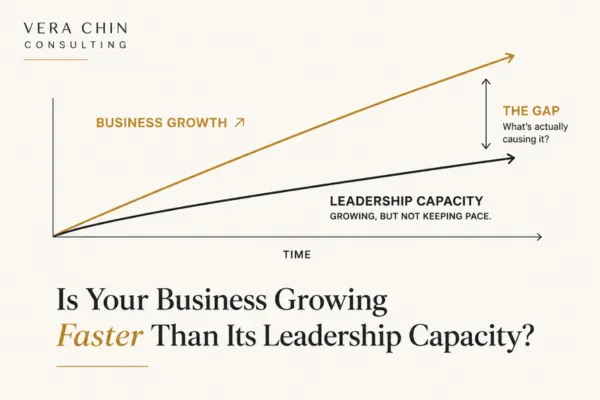
Business Growth vs Leadership Capacity | Vera Chin
Years ago, I worked in a business during a period of significant growth.
Things were going well. We were winning work, the business was expanding, and there was plenty to be optimistic about.
But I remember raising a concern with the other leaders in the business at the time.
I wasn't worried about whether we could keep winning work.
I was concerned about whether we were developing the leadership capability we would need to sustain what we were building.
We had highly capable people with strong technical expertise.
But I could see that as the business became bigger, leading it was becoming more complex too.
The leadership capability that had helped the business reach one stage wasn't necessarily going to be enough to carry it through the next.
Over time, I watched some very capable people leave.
Eventually, I left too.
There were many factors involved, as there usually are when people leave an organisation. It would be far too simplistic to attribute what happened to one leadership issue.
That experience left me with a question I've continued thinking about, and eventually an answer.
Winning growth and having the capacity to carry it are not necessarily the same thing.
Can a business grow faster than its capacity to lead that growth?
I think it can.
Growth requires capacity to carry growth
When we talk about business growth, we naturally think about strategy.
How do we win more clients?
Increase revenue?
Enter a new market?
Improve our systems?
Hire more people?
All of those things matter.
But growth also creates something less visible:
greater leadership complexity.
A five-person business doesn't operate like a 20-person business.
A 20-person business can't necessarily be led like a five-person business.
Decisions multiply.
Communication becomes more complex.
The owner has less visibility over everything happening in the business.
People further from the top need to exercise greater judgement.
Managers who were excellent at doing the work themselves may now need to lead other people doing it.
And eventually, the business reaches a point where individual effort can no longer compensate for insufficient leadership capacity.
Sometimes growth doesn't create the leadership problem.
It exposes a capacity problem that was previously manageable.
When I talk about leadership capacity, I don't mean job titles or how many managers a business has. I mean the growing ability within a business to think, decide, communicate, exercise judgement and carry responsibility at the level the business requires. That capacity can exist at every level, not just at the top.
The warning signs don't always look dramatic
This is part of what makes a leadership-capacity problem difficult to recognise.
The business may still be performing.
Clients are being served.
People are busy.
Revenue may still be growing.
Nothing appears to be seriously broken.
But underneath that activity, you might start noticing things like:
Decisions repeatedly moving upwards.
The same people becoming the escalation point whenever something unusual happens.
Strong performers quietly absorbing gaps.
Managers who can keep today's workload moving but struggle when the situation requires greater judgement or leadership.
Problems waiting because only one person can make the call.
The owner being pulled back into issues they thought they had already delegated.
Inconsistent decisions or client experiences depending on who happens to be involved.
None of these automatically means you have a leadership-capacity problem.
But when they become patterns, they're worth paying attention to.
Because the business may be growing faster than its capacity to lead it.
Where is the constraint actually sitting?
When decisions or problems repeatedly return to the leader, one response I often hear is:
“I need my people to take more ownership.”
Maybe.
But that's a conclusion.
It doesn't yet tell us where the constraint actually sits.
Before deciding the answer is more delegation, more training, more motivation or tighter accountability, it's worth asking:
What is actually missing?
Is it capability?
Does the person genuinely have the skills, experience and judgement required for the responsibility?
Sometimes the answer is no.
Someone may be excellent at their current role without yet being ready to carry the next level of complexity.
Giving them more authority won't automatically solve that.
They may need experience, coaching, feedback or opportunities to progressively build their capability.
Is it context?
Sometimes the person is capable, but they're trying to make decisions without enough of the bigger picture.
As responsibility increases, context becomes more important.
That doesn't mean everyone needs access to everything.
Some information is confidential.
Some decisions involve considerations that appropriately remain with senior leadership.
But if we're asking someone to exercise judgement, they need enough appropriate context to understand what they're exercising judgement about.
What are we trying to achieve?
Why does this matter?
What other considerations affect the decision?
What constraints are we working within?
Without enough context, capable people can still become dependent on the person who holds it.
Is it clarity?
Sometimes the problem isn't capability or information.
It's that the person doesn't actually know what they're responsible for.
What does success look like?
What matters most?
Where are the boundaries?
Which decisions are theirs?
When should they make the call themselves, and when should they escalate?
Telling someone to “take ownership” while leaving those things ambiguous can create frustration on both sides.
The leader thinks:
Why does everything keep coming back to me?
The employee thinks:
I'm not sure I'm actually allowed to decide this.
Is it authority?
This is where responsibility and authority can become disconnected.
Someone can be accountable for delivering an outcome while still needing approval for every meaningful decision required to achieve it.
The work has moved down.
The authority hasn't.
Sometimes that's appropriate. Not every decision should be delegated.
But if we want capable people to carry greater responsibility, appropriate decision-making authority eventually has to travel with that responsibility.
Otherwise, the leader remains necessary for progress.
Is it accountability?
And sometimes we need to be careful not to turn every performance issue into a leadership failure.
The person may have the capability.
They may understand the context.
The expectations may be clear.
They may have appropriate authority.
And they're still not taking responsibility.
That's a different conversation.
Adults remain responsible for their own behaviour, development, judgement and work.
Building the conditions for ownership doesn't mean removing accountability.
It means understanding whether the problem is genuinely accountability before treating it as one.
Is it leader capacity?
Sometimes the person carrying the responsibility isn't the constraint at all.
They may have the capability, context, clarity and appropriate authority they need.
But too many decisions still depend on the leader.
Perhaps important organisational context remains concentrated with them.
Their attention may be divided across clients, people, operations and growth.
Or the business may simply have reached a level of complexity where too much still depends on one person being available to make the call.
This isn't necessarily about a leader being unwilling to let go.
Sometimes the way leadership currently operates has simply stopped being sufficient for the size and complexity of the business.
And that raises a different question:
Does the business need its people to carry more, or does it need to change how leadership itself operates?
These aren't the only possibilities.
The constraint could be motivation, fit, competing priorities, systems, workload or something else entirely.
And more than one constraint can exist at the same time.
The important thing is not to prescribe before we've diagnosed.
Because building leadership capacity will look different depending on where the constraint sits.
For one person, development may mean learning to make decisions without seeking reassurance every time.
For another, it may mean learning to give clearer direction rather than simply taking the work back.
For a manager, it might mean becoming capable of addressing a performance issue rather than escalating every difficult conversation.
For an owner, it may mean learning which decisions genuinely require their involvement and which ones they need to stop holding.
Build the capacity before you desperately need it
This is the difficult part.
Leadership development rarely feels as urgent as today's client problem.
There's always something more immediate.
Revenue needs attention.
A deadline is approaching.
Someone needs an answer.
A client needs help.
And leadership capacity can wait.
For a while, it often can.
The business finds ways to compensate, and the work keeps moving.
That's what makes the issue so easy to postpone.
But developing greater leadership capacity takes time.
People need opportunities to exercise judgement before the stakes become enormous.
They need experience making decisions.
They need feedback.
They need increasing responsibility as their capability grows.
And leaders need to learn when to provide direction, when to provide context, when to make the decision themselves and when to get out of the way.
The cost of waiting isn't always obvious either.
Nothing necessarily collapses overnight.
Instead, the patterns already described tend to become more entrenched.
Decisions can take longer when too much still depends on too few people. And as the business grows more complex, that dependency can become harder to unwind, not easier.
There can be a people cost too.
Capable people may eventually decide they no longer want to keep compensating for gaps around them, or that they have more opportunity to grow somewhere else.
I've experienced what it's like to watch capable people leave a growing business, and eventually to make that decision myself. I wouldn't attribute those decisions to any single leadership issue.
But it reinforced something I've continued to believe:
You can't wait until the business has outgrown your current leadership capacity to start building more of it.
You don't need to remove yourself from every decision.
And you shouldn't push authority onto people who aren't ready to carry it.
The goal isn't independence for the sake of independence.
It's building enough leadership capacity across the business that growth doesn't remain dependent on a handful of people continually compensating for what the organisation hasn't yet developed.
Because a sound strategy still needs the capacity to carry it.
Which raises the real question:
Does this business have the leadership capacity required for where you're asking it to go next?
FAQ
What is leadership capacity in a business?
Leadership capacity is the growing ability across a business to think, decide, communicate, solve problems, exercise judgement and carry responsibility at the level the organisation requires.
How do I know if my business lacks leadership capacity?
Common signs include decisions repeatedly escalating to the owner, strong performers absorbing gaps, managers struggling with increasing complexity, delayed decisions and too much responsibility depending on a small number of people.
How can a business build leadership capacity?
Start by diagnosing what's creating the dependency. The constraint may sit with the people carrying the responsibility, such as capability, context, clarity, authority or accountability, or with the leader themselves if too much still depends on their availability. Different constraints call for different responses.
When too much still depends on you
If your business is growing but too many decisions, problems or responsibilities still find their way back to you, don't assume you simply need to delegate more.
First, work out what's creating the dependency.
That's the kind of challenge I work through with business owners in Business Breakthrough™.
We identify where the constraint actually sits and what needs to change for the business to carry more without everything depending on you.
If this sounds familiar, send me BREAKTHROUGH and let's have a conversation.


